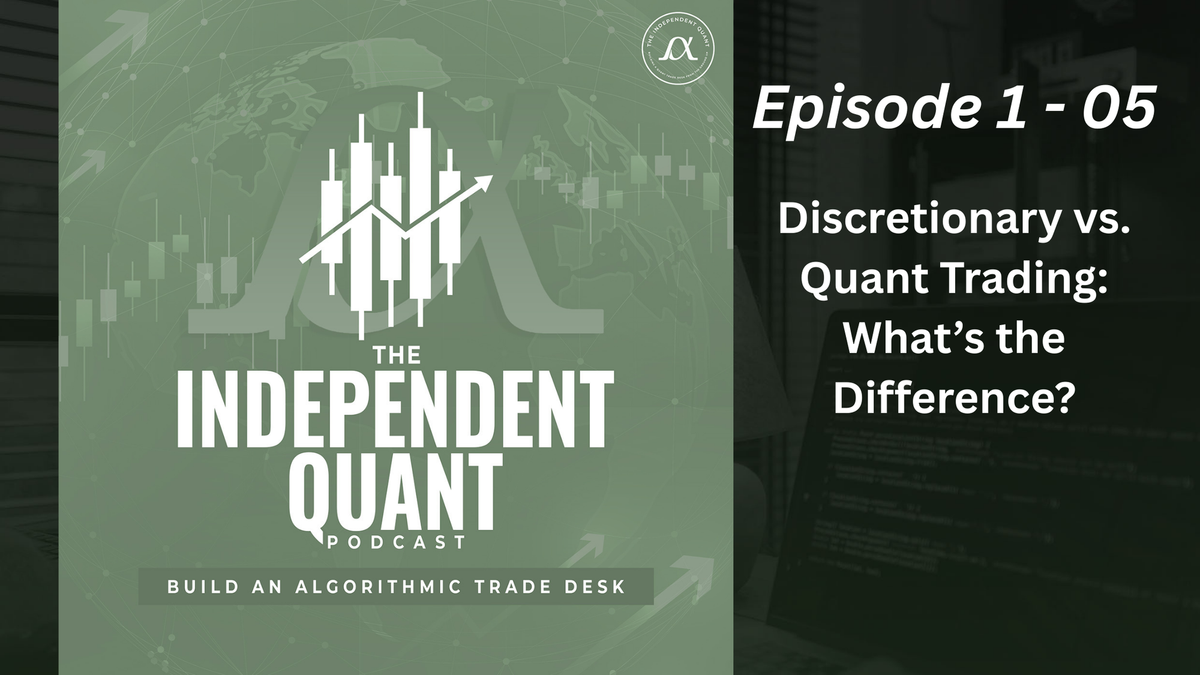
TIQ Podcast Episode 1-05: Discretionary vs. quant trading what’s the difference
Exploring the World of Trading: Discretionary vs. Quantitative
In the ever-evolving world of trading, two primary methodologies stand out: discretionary trading and quantitative trading. Each approach has its unique characteristics, advantages, and challenges. In this post, I'll delve into these two trading styles, drawing from insights shared by Luis Martinez in the Independent Quant podcast.
Overview
Trading the financial markets can be approached in various ways, but the two most prominent methods are discretionary trading and quantitative trading. Discretionary trading relies on a trader's intuition and judgment, while quantitative trading employs systematic, rule-based strategies often executed via algorithms. Understanding the differences and nuances between these approaches can help you determine which method aligns best with your trading style and goals.
3 Big Ideas
1. Discretionary Trading: The Art of Intuition
Discretionary trading is a manual approach where traders rely on their gut feel, news, and market context to make trading decisions. This method is highly emotional and requires a deep understanding of market dynamics.
- Example: Price action trading, where traders analyze price movements on charts without using indicators.
- Challenges: Emotional control is crucial, and it's difficult to backtest strategies due to the subjective nature of decision-making.
- Advantages: Flexibility to adapt to market conditions and a deep understanding of market context.
2. Quantitative Trading: The Science of Systematic Strategies
Quantitative trading involves using a rule-based, systematic approach to identify entry and exit points. This method leverages statistics and historical data to inform trading decisions.
- Backtesting: Allows traders to simulate how a strategy would have performed in the past.
- Forward Testing: Validates the strategy in a simulated environment before going live.
- Advantages: Emotion-free trading, scalability, and the ability to run multiple strategies simultaneously.
3. Choosing the Right Approach
The choice between discretionary and quantitative trading depends on your personal preferences and trading style.
- Discretionary Trading: Ideal for those who enjoy actively monitoring the market and making intuitive decisions.
- Quantitative Trading: Suited for those with an analytical mindset, comfortable with programming, and prefer data-driven decisions.
Why It Matters
Understanding the differences between discretionary and quantitative trading is crucial for several reasons:
- Performance: Each method has its own set of challenges and advantages that can impact your trading performance.
- Risk Management: Knowing which approach aligns with your risk tolerance and trading goals can help you manage your portfolio more effectively.
- Scalability: Quantitative trading offers better scalability as your account grows, whereas discretionary trading can become mentally taxing with larger positions.
How to Apply It
For Discretionary Traders:
- Develop Emotional Control: Practice managing your emotions to make better trading decisions.
- Stay Informed: Keep up with market news and economic indicators to make well-informed trades.
- Flexibility: Be prepared to adapt your strategies based on current market conditions.
For Quantitative Traders:
- Learn Programming: Gain proficiency in a programming language like Python to code your strategies.
- Backtest and Forward Test: Rigorously test your strategies to ensure they are robust and effective.
- Stay Updated: Keep abreast of market regime changes and adapt your strategies accordingly.
Key Takeaways
- Discretionary Trading relies on intuition and market context, offering flexibility but requiring strong emotional control.
- Quantitative Trading uses systematic, rule-based strategies, providing emotion-free trading and scalability.
- Choosing the Right Approach depends on your trading style, risk tolerance, and comfort with technology.
Optional: Transcript Highlights
- "Discretionary trading is a very manual way to approach the markets. It's very emotional in nature."
- "Quantitative trading is very much just a rule-based, systematic approach to the markets."
- "The advantages of quantitative trading... is that emotion-free trading."
- "If you enjoy actively looking at the market and the challenge of just overcoming yourself... then maybe discretionary trading is for you."
- "If you're comfortable with programming and computers and managing a portfolio... then I think in your heart, you're a quantitative trader."
Call to Action
Whether you lean towards discretionary trading or quantitative trading, the key is to understand the methodologies deeply and choose the one that aligns with your trading style and goals. If you're interested in exploring quantitative trading further, consider joining the Independent Quant community. Sign up for their newsletter to stay updated on the latest developments and resources. Happy trading!