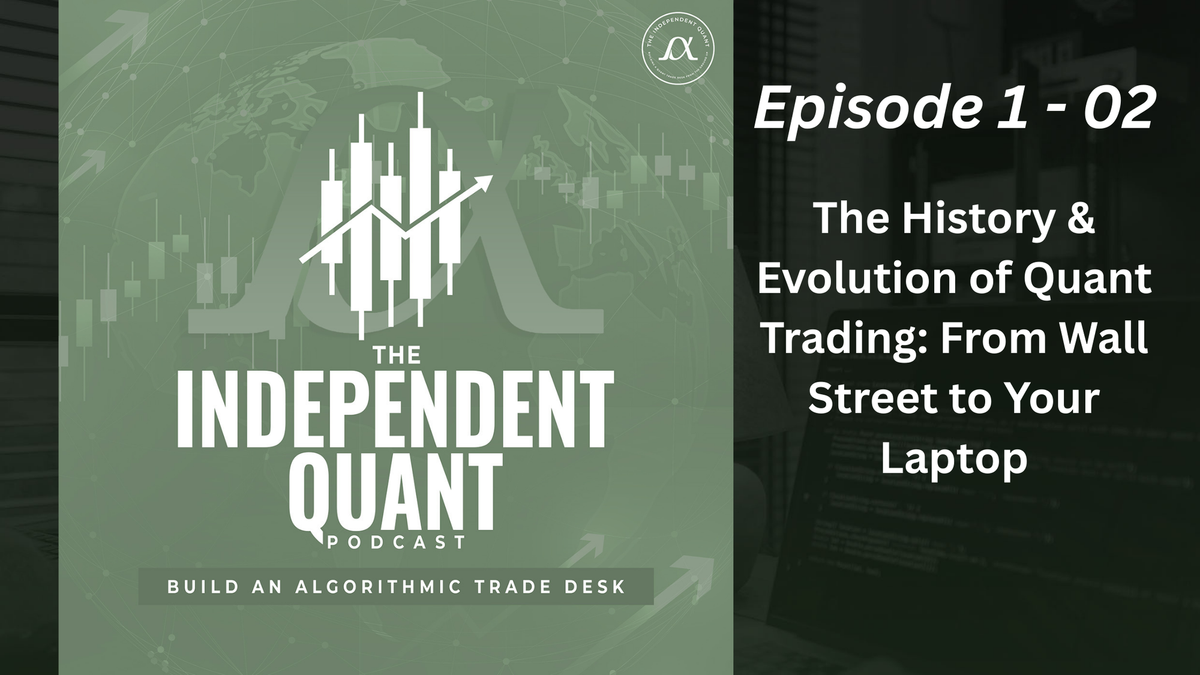
TIQ Podcast Episode 1-02: The history & evolution of quant trading from wall street to your laptop
The Evolution of Quantitative Trading: From Theory to Today
Quantitative trading, often perceived as a modern phenomenon, has deep roots that trace back to the 1950s. In this post, we'll explore the fascinating journey of quantitative trading, from its theoretical beginnings to its current status as a cornerstone of modern finance. We'll delve into three pivotal phases of its development, understand why it matters, and discuss how you can apply these insights to your own trading strategies.
Overview
Quantitative trading, or "quant trading," involves using mathematical models and algorithms to make trading decisions. Contrary to popular belief, it's not a recent invention. The seeds of quant trading were sown in the 1950s, with significant theoretical contributions from figures like Harry Markowitz and Eugene Fama. Over the decades, advancements in computing power and the advent of the internet have transformed quant trading from a theoretical concept into a practical, widely-used strategy.
1. The Theoretical Foundations (1950s-1980s)
The roots of quantitative trading can be traced back to the 1950s and 1960s, a period marked by significant theoretical advancements. Key figures like Harry Markowitz, who developed the Modern Portfolio Theory, and Eugene Fama, who introduced the Efficient Market Hypothesis, laid the groundwork for what would become quant trading.
Ed Thorpe, often considered one of the founders of quant trading, began applying probability theory to trade statistical arbitrage and option pricing models. However, the computing power available at the time was limited. Programming was in its infancy, with punch cards and early versions of Fortran being the norm. Despite these limitations, the theoretical foundations were established, providing a mathematical approach to the markets.
2. The Birth of Options and Electronic Trading (1970s-1990s)
The 1970s saw the introduction of options as a financial instrument, though they weren't initially popular. The Black-Scholes model, developed to price these options, revolutionized the field and earned its creators a Nobel Prize. This period also witnessed the beginnings of electronic trading, though personal computers were still in their early stages.
By the 1980s and 1990s, personal computers had become more powerful and smaller, enabling more sophisticated electronic trading. Firms like Citadel and Getco began engaging in high-frequency trading, taking advantage of the increased computing power. The Pentium chip, introduced in the mid-90s, was a monumental achievement that further boosted computing capabilities.
3. The Democratization of Quant Trading (2000s-Present)
The early 2000s marked the beginning of the democratization of quant trading. The internet became more robust, and programming languages like Python and R gained popularity. The rise of big data and alternative data sources in the late 2000s and early 2010s further transformed the landscape.
The introduction of cloud computing with services like AWS's S3 in 2004 made it possible to process vast amounts of data. Machine learning began to hit its stride in the mid-2010s, offering new ways to analyze and act on market data. Today, generative AI has taken quant trading to new heights, allowing for the creation of strategies through simple interactions with technology.
Why It Matters
Understanding the history and evolution of quantitative trading is crucial for several reasons:
- Informed Decision-Making: Knowing the theoretical and technological foundations helps you make informed decisions about whether quant trading aligns with your financial goals.
- Competitive Edge: In today's market, relying solely on traditional trading methods can put you at a disadvantage. Quant trading offers a systematic approach that can enhance your decision-making process.
- Future-Proofing: As technology continues to advance, staying abreast of quant trading developments ensures you remain competitive and adaptable.
How to Apply It
If you're managing your own funds and investing your own money, exploring quant trading is worthwhile. Even if you don't fully embrace algorithmic strategies, using them to locate signals or determine whether to take a trade can give you a significant edge.
Here are some steps to get started:
- Educate Yourself: Begin with the basics of quantitative trading. There are numerous resources available, including online courses and podcasts.
- Learn a Programming Language: Python and R are popular choices for quant trading. Start with the basics and gradually build your skills.
- Utilize Cloud Services: Take advantage of cloud computing to process large datasets and run complex algorithms.
- Experiment with Machine Learning: Explore machine learning algorithms to enhance your trading strategies.
- Stay Updated: The field of quant trading is constantly evolving. Stay informed about the latest developments and technologies.
Key Takeaways
- Quantitative trading has a rich history dating back to the 1950s.
- The 1970s and 1980s saw the introduction of options and the beginnings of electronic trading.
- The 2000s marked the democratization of quant trading, thanks to advancements in computing power, the internet, and programming languages.
- Staying informed and experimenting with quant trading can give you a competitive edge in today's market.
Optional: Transcript Highlights
- "Quantitative trading or start to build in the 1950s with Markowitz and the Modern Portfolio Theory."
- "The Black-Scholes model was developed... gentlemen who drafted that were awarded a Nobel Prize."
- "In the 80s, started seeing electronic trading started to take off."
- "As we came into the 90s, that really started to shift because we started seeing firms like Citadel and Getco started getting into high frequency trading."
- "The introduction of cloud computing with services like AWS's S3 in 2004 made it possible to process vast amounts of data."
If you're intrigued by the world of quantitative trading and want to explore it further, head over to theindependentquant.com. Sign up for weekly podcasts that dive deep into all matters related to quantitative trading. Additionally, courses are available to help you get started on your quant trading journey. Don't miss out on the opportunity to enhance your trading strategies with the power of quantitative methods.